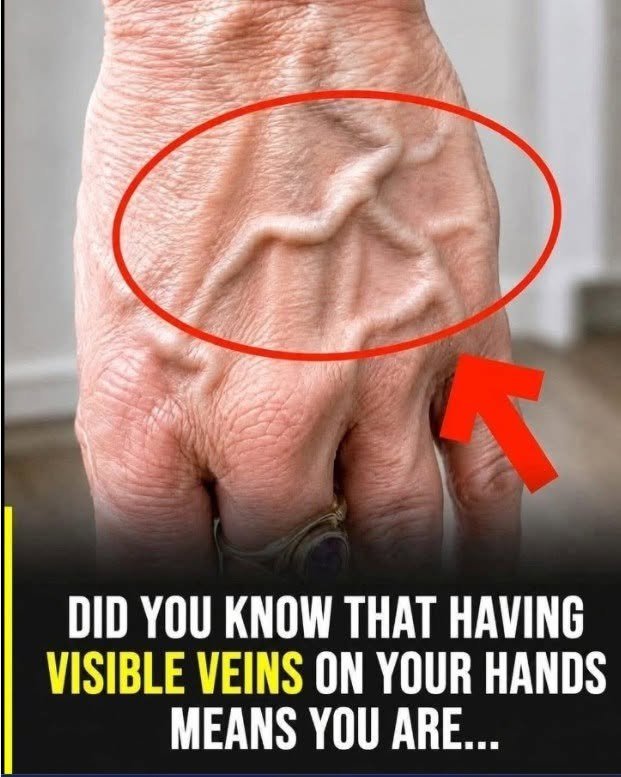
Have you ever noticed that the veins on your hands, arms, legs, or feet suddenly look more prominent?
Visible veins can sometimes look concerning, but in many cases, they are simply a normal feature of the body. Several factors can make veins easier to see, including genetics, body composition, temperature, physical activity, age, and hydration.
So what does having visible veins actually mean?
1. You May Naturally Have Prominent Veins
Some people simply have veins that are closer to the surface of the skin.
Genetics can influence the size, location, and visibility of superficial veins. If visible veins run in your family, you may naturally have them too.
2. Lower Body Fat Can Make Veins More Noticeable
When there is less tissue between the skin and superficial veins, those veins may become easier to see.
This is one reason athletes and people with lower body fat may notice more visible veins in their arms and hands.
However, visible veins are not a reliable measure of fitness or health by themselves.
3. Exercise Can Temporarily Make Veins Stand Out
After exercise, increased blood flow to working muscles can make superficial veins appear more prominent.
You may notice this particularly after strength training or intense physical activity.
This effect is usually temporary and should become less noticeable as your body returns to its resting state.
4. Heat Can Make Veins More Visible
Hot weather, a warm shower, or exercise in a warm environment can cause blood vessels near the skin to widen.
As a result, veins may appear larger or more noticeable.
This is generally a normal response to changes in temperature.
5. Aging Can Change the Appearance of Your Veins
As people age, the skin gradually becomes thinner and loses some of its elasticity.
Changes in the tissues beneath the skin can also make superficial veins easier to see.
Therefore, veins that were barely noticeable when you were younger may become more visible over time.
6. Pregnancy Can Increase Visible Veins
During pregnancy, blood volume increases and the growing uterus can affect blood flow from the lower body.
As a result, veins may become more prominent, particularly in the legs.
Some changes disappear after pregnancy, although certain enlarged veins can persist.
When Should Visible Veins Be Checked?
Visible veins are often harmless, but a new or sudden change deserves more attention if it occurs together with other symptoms.
Contact a healthcare professional if a vein becomes painful, swollen, warm, red, hard, or unusually tender.
Sudden swelling or pain in one leg, especially when accompanied by unexplained shortness of breath or chest pain, requires urgent medical evaluation.
What About Bulging Veins in the Legs?
Prominent, twisted, or enlarged veins in the legs may sometimes be varicose veins.
They can cause aching, heaviness, swelling, itching, or discomfort, although some people have them without symptoms.
If leg veins are becoming increasingly prominent or uncomfortable, a healthcare professional can determine whether they need evaluation or treatment.
The Bottom Line
Having visible veins does not automatically mean that you are extremely fit, dehydrated, unhealthy, or suffering from a medical condition.
For many people, prominent veins are simply part of their normal anatomy and may become more noticeable because of genetics, exercise, body composition, heat, pregnancy, or aging.
What matters most is whether the appearance is new and whether it is accompanied by symptoms such as pain, swelling, redness, warmth, or sudden changes.
Visible veins alone are usually nothing to worry about—but unusual changes should not be ignored.